AI-Assisted Scope Gap Detection in Mechanical Bid Documents
AI catches scope gaps across divisions that human reviewers miss under bid-window time pressure.
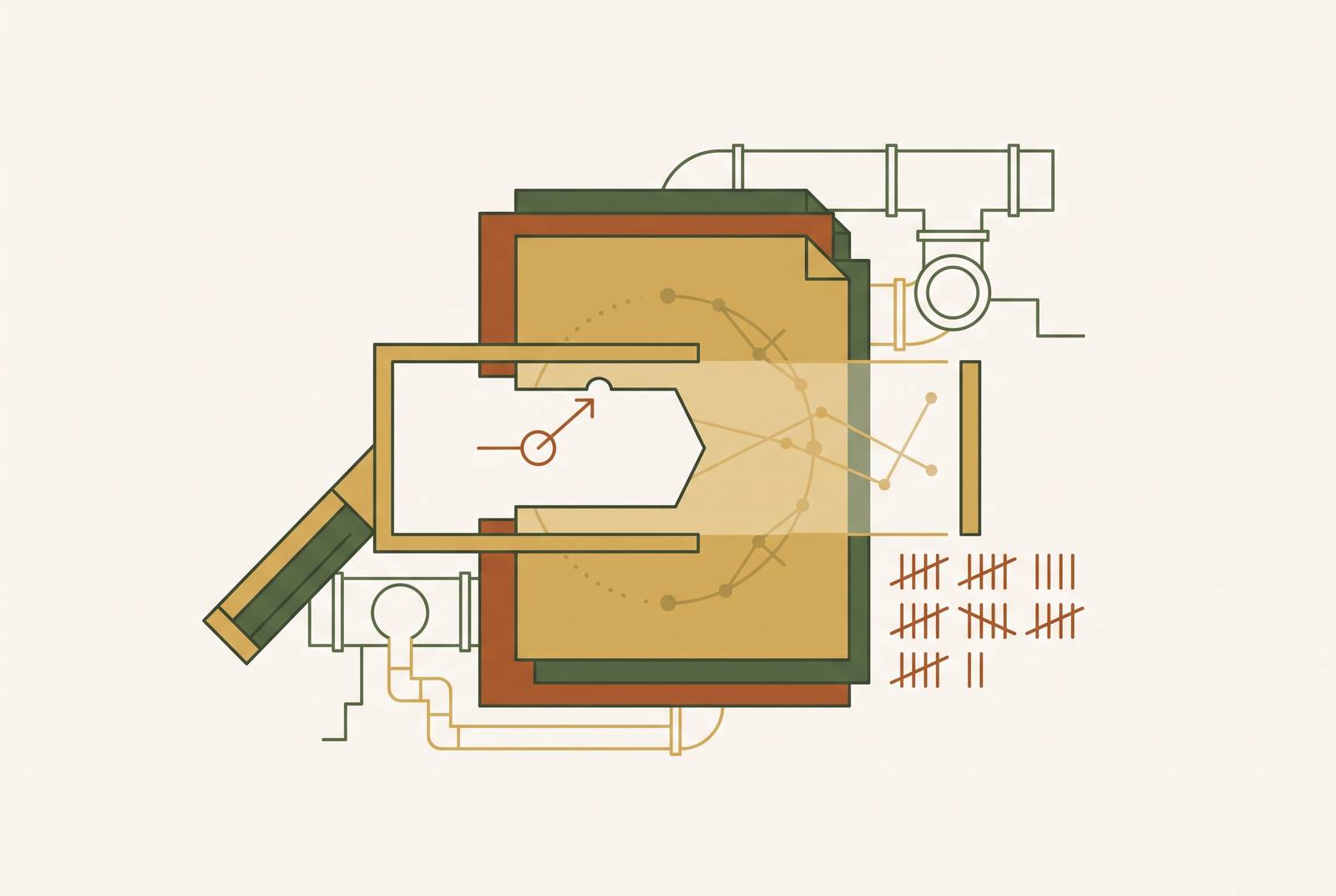
Mechanical bid packages fail in a specific, predictable way: the scope gets split across three CSI divisions at once, and nobody signs their name to the seams between them. That's the subject of this piece, and the reason AI-assisted detection tools have found real traction in mechanical preconstruction over the past year. The logic is not complicated, but the cost of getting it wrong is.
A mechanical package touches Division 22 (Plumbing), Division 23 (Mechanical/HVAC), and Division 25 (Integrated Automation), often on the same set of drawings. No other trade bid spans three divisions simultaneously the way mechanical does, and that structural fact is the root of most of what follows. Controls, testing and balancing, and commissioning are the usual flashpoints: a controls sequence can sit in Division 23, get referenced again in Division 25, and appears a third time buried in a general contractor's Division 01 general requirements. Three places to claim it, and often zero bidders who actually do.
The rest of the gaps hide in what nobody wrote down. A mechanical estimator assumes the plumbing sub is handling the boiler room floor drain. The electrical sub excludes conduit trenching because that's standard practice on their last five jobs. Nobody's proposal covers the curb under the rooftop unit, because everyone assumed it belonged to someone else's scope. None of this is written into any spec section. It's inherited assumption, and inherited assumption is what falls through at the trade interface.
Specific examples repeat often enough to qualify as patterns. Laboratory jobs frequently carry specialty process piping that never lands in any mechanical bid scope because it doesn't fit neatly under plumbing or HVAC. Retail tenant improvement jobs routinely assume after-hours shutdown labor, premium-rate work that nobody actually assigns to a line item. And vibration isolation on rooftop units, specified in Division 23, shows up unaddressed in bid after bid, because it's a detail easy to read past when you're pricing tonnage and airflow instead.
What scope gaps cost on a mechanical project
Scope gaps appear first as change orders, and change orders add up fast: 5 to 15% on top of the original contract value is the typical range for what scope gaps add through change orders in a commercial project.
That's the project-level cost. The average scope dispute has been put at $340,000, a number that reads differently once you account for how technically dense mechanical scope disputes tend to be compared to disputes in simpler trades. Piping systems, controls sequences, and equipment schedules take longer to untangle in a courtroom or an arbitration hearing than a drywall boundary dispute does, and the legal and expert-witness costs scale with that complexity.
Arcadis' Global Construction Disputes Report has named "errors and omissions in contract documents" the number one cause of construction disputes in a country's market. construction disputes in six of the past nine years. Mechanical documents, spread across multiple drawing sets and three spec divisions, are structurally more prone to exactly that failure mode than a single-division trade package. That's not a coincidence: it's a direct consequence of how many places a mechanical scope item has to be consistently described in order to actually get built.
Zoomed out far enough, the number gets uncomfortable. The average dispute of that kind. The same Arcadis reporting put the construction dispute at $60.1 million. Most scope gaps never escalate that far. But the mechanism that produces a $340,000 dispute and the mechanism that produces a $60.1 million one is the same mechanism: an ambiguity that sat unresolved from bid day forward until somebody had to pay for it.
Document and process failures that create silent gaps
Drawings and specifications are supposed to say the same thing in two different formats: drawings show design intent, specs define how it gets executed. When those two documents drift out of alignment, a detail can exist in one and vanish, get altered, or get contradicted in the other, and nothing in the bid process forces anyone to notice until the work is underway.
Addenda make this worse, not better. Every reissued drawing set can quietly reassign which trade owns a given system, and estimators working against a deadline often check addenda against their original scope sheet instead of an updated one. The revision gets logged. The scope sheet doesn't. The work falls through a crack nobody built on purpose.
A real case makes the stakes concrete. An electrical subcontractor called AMP believed excavation and backfill for underground conduit sat outside its subcontract scope. Addenda 2 and 3 had, in fact, clarified that the work belonged to AMP. An appeals court ruled against the subcontractor, and AMP absorbed both the cost of the work and the legal fees for having argued the point. The lesson generalizes cleanly to mechanical scope: bid against a superseded document, and the fact that you didn't know it was superseded is not a defense.
Human review has a ceiling, and it is a real one even though it is not low. A full project document set can run past 2,000 pages, and bid windows don't stretch to match. An estimator can count every diffuser and terminal unit correctly and still miss an addendum revision buried deep in the document set, an access constraint noted once in a general condition, or a commissioning clause tucked into Division 01 where nobody on the mechanical team was told to look.
What AI-assisted detection does: the cross-referencing logic
The capability that actually changes the math is simultaneous multi-document processing. Instead of reading a drawing set, then a spec book, then a contract, then a stack of addenda in sequence (the way a human estimator has to, one document at a time), the system reads all of them as one connected structure. A scope item present in the drawings but absent from the specs gets flagged as a structural gap, not written off as a page someone skimmed too fast.
Natural language processing built to extract requirements straight out of spec language, including Division 22, 23, and 25 text, and check that language against what bidders actually priced, produces the ability to compare stated requirements against priced line items, visible in how the system flags mismatches between spec text and bid content. That's the mismatch-detection layer: not "does this document exist" but "does this document's stated requirement have a matching line item anywhere in the bid."
In a live bid comparison, that logic produces something concrete. The system might flag that Bidder A excluded commissioning services entirely, that Bidder B included them, that Bidder C's proposal cites an addendum that's already been superseded, and that none of the three bidders priced the vibration isolation called out in Division 23, all inside a single comparison pass rather than three separate manual reviews.
Addenda tracking is its own specific problem, and it's the one most likely to blindside an experienced estimator. Trunk Tools' Cortex intelligence layer, launched in June 2026 and trained on real project data, is built to catch drawing changes that fall outside the revision cloud, the visual marker meant to flag what changed on a reissued sheet. Engineers revise equipment schedules and piping notes without always redrawing the cloud around them. That's not sloppiness so much as a known gap in how design-software revision conventions get followed under deadline pressure, and it's exactly the kind of change a page-by-page human read is likely to miss.
Where AI detection fits inside the mechanical bid workflow
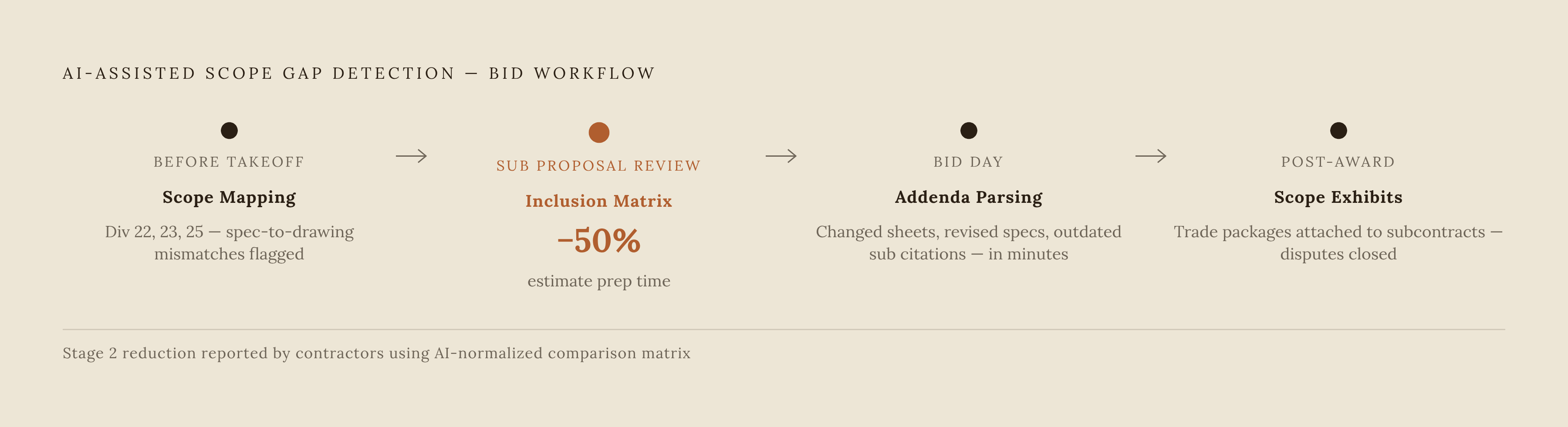
The first checkpoint comes before takeoff even starts. Drawings and spec sections go in, and the system maps scope items across Division 22, 23, and 25, flags places where spec coverage doesn't match what the drawings show, and identifies boundary ambiguity between divisions before an estimator has sunk hours into quantities that might be wrong or double-counted.
The second checkpoint happens once subcontractor proposals start arriving, and this is where the labor savings become most visible. Comparing sub proposals line by line, across PDFs that never use the same format twice, is one of the most time-consuming parts of preconstruction. AI tools extract structured inclusions and exclusions out of each proposal and build a normalized comparison matrix, and some contractors have reported cutting estimate preparation time by as much as half.
The third checkpoint is bid day itself, when a late addendum lands in the final hour before submission. Instead of a re-read of the whole package under time pressure, the system identifies which sheets changed, which spec sections got revised, which trade's responsibility shifted, and which subs' proposals now cite documents that are already outdated. That's a prioritized list an estimator can act on in minutes.
The fourth checkpoint comes after award, and it's the one that closes the loop on disputes before they start. AI-generated scope packages, broken out by trade, get attached to subcontracts as exhibits. What each trade is actually carrying gets written down explicitly instead of assumed, which is the single change most likely to prevent the kind of dispute one prior project saw from happening on the next job.
The tools handling mechanical scope gap detection in 2026
Not all these tools solve the same problem, and mechanical teams need to know which part of their workflow a given product actually touches, whether that's takeoff, spec-to-drawing review, or bid comparison.
Provision is built specifically for pre-construction scope and contract risk review, and it handles bulk document processing at a scale that matters for mechanical packages: up to 100,000 pages of plans, specs, and contracts in a single pass. Its Scope Agent reads drawings, specs, tables, and symbols in construction-specific context, and generates trade-broken scope packages covering mechanical, plumbing, and controls items, flagging gaps, scope creep, and contradictions with citations back to the exact source document. That agent became generally available as of Provision's August 2026 announcement. A separate Risk Review module runs submissions against pre-built checklists (Contract Review, Estimator Review, Tariff Checklist, PM Playbook, Go/No-Go Review, Subcontractor Review, RFP Review, Geotechnical Report Review), with support for custom checklists as well. A Chat Agent answers document questions with citations attached, has fielded over 50,000 queries across real project documents, and handles addenda triage on bid day. Provision reports, on its own platform figures, having reviewed $100 billion in project value, processed 66,000 documents, surfaced more than 1,000,000 risks, and hit 95% verified accuracy on real project documents.
Trunk Tools, founded in 2021 by CEO Sarah Buchner (whose background runs through carpentry and general contracting to advanced academic work in engineering), takes a different architectural approach: a construction ontology and project knowledge graph that links specs, drawings, submittals, RFIs, and schedules together, built natively around the document taxonomy that runs from Division 01 through complex MEP drawing sets. Its named agents split the work by function: TrunkReview, TrunkBid for bid package comparison and exclusion surfacing, TrunkSubmittal for submittal-related document review, and TrunkText for cross-document Q&A. Trunk Tools has reported enterprise agreements with major general contractors expanding its field deployment in 2026.
Document Crunch's engine analyzes contracts and specifications, flags clauses that work against the contractor, checks for inconsistencies between contract language and spec language, compares document versions against each other, and produces plain-language playbooks out of the result. Every flag ties back to its source clause, which matters directly for mechanical disputes, where figuring out which division or which party actually owns a piece of scope has to be traceable, not asserted. In preconstruction, the tool runs a firm's own review playbook against incoming documents, catching spec-to-contract conflicts before pricing even begins.
What detection requires from the bid team
None of these tools resolve a gap. They surface it. When the system flags that no bidder priced vibration isolation on the rooftop units, a person still has to decide the response: an allowance, an RFI to the design team, or a scope reassignment to a specific sub. The decision stays human. The tool just makes sure the decision gets made before bid day instead of during a change order fight eight months into construction.
Document quality sets a ceiling that no detection tool can lift on its own. If Division 23 and Division 25 genuinely contradict each other on who owns the controls sequence, the AI will flag that contradiction accurately, but somebody on the design team still has to resolve it. Earlier detection buys time to fix the problem. It doesn't fix the problem by itself.
Process consistency matters just as much as the software. Without a standard scope-package format and a standard gap-report format applied across every pursuit, a firm never builds institutional memory, and that institutional memory is what lets a tool's historical pattern detection actually get sharper project over project. A tool used differently on every bid is a tool that never compounds.
And citations are not optional. Every flagged gap needs to trace back to a specific drawing sheet, a specific spec section, or a specific addendum number. An uncited flag might be correct, but it's useless in the room that matters: a subcontract negotiation, or a change order dispute where somebody is going to ask exactly where that requirement came from.
Sources
- How AI Agents Automate Scope Gap Detection Between Vendor Proposals in Construction | Datagrid Blog | Datagrid
- Scope Gap Detection Guide | Construction Bid Analysis
- Construction Tech for Bid Accuracy: Top 7 Tools for GCs in 2026
- Pre-Bid Scope Gap Review: A Step-by-Step Guide for GCs (2026)
- How Scope Gaps Become Change Orders: A $340K Problem for General Contractors
- Beware ‘scope gaps’; one subcontractor found out the hard way with court loss
- enr.com