AI Takeoff vs Manual Digitizer Takeoff Productivity Comparison
AI speeds up routine takeoffs 90%, but manual review still catches what it misses.

Two takeoff methods run side by side in construction estimating today, and the gap between them is no longer a matter of opinion. AI-driven takeoff cuts measurement time on repetitive, well-drawn scopes by wide margins, often 90% or more against manual work. Manual, human-driven judgment still catches the spec conflicts and scope gaps that AI tools were never built to see. Estimating departments face one real task heading into 2026: split the job so each method does what it's good at, and most firms have the split backwards, letting AI touch scopes it can't handle reliably while under-using it on the scopes where it's already faster and just as accurate.
Nearly 500,000 construction workers are needed in 2026, and a large share of the current estimating workforce is nearing retirement, so the pool of experienced estimators is shrinking. Firms can't hire their way out of that math. Speed and capacity have turned into the competitive edge, not a nice-to-have, and a bad estimate costs more now than it did five years ago, since material prices are climbing faster than bid prices on most jobs. That pressure is why estimating software has grown into a market worth billions. It's how the work gets done now.
What manual digitizer takeoff involves day to day
Paper and a scale ruler are mostly gone. When people say "manual" takeoff in 2026, they mean on-screen tools where the estimator does every measurement and count by hand, clicking through digital plan sets instead of walking a printed sheet with a wheel.
The work runs deeper than clicking, though. An estimator cross-references drawings against spec sections, hunting for the places where what's drawn doesn't match what's written. They apply waste factors, adjust for site conditions, work out phasing logic for how material gets sequenced onto the job. And they look for scope gaps between trades before those gaps turn into change orders, often the most valuable and least visible part of the job.
Three tools dominate this space, and they split the work differently. PlanSwift remains the Windows desktop standard, now shipping with a "Takeoff Boost" suite that adds AI-powered automation: Auto Takeoff, Auto Count, Auto Scale, Auto Bookmark. It runs around $1,749 to $2,000 a year on subscription, or $1,595 to $1,749 as a perpetual license plus roughly $250 a year for updates, with trade plugins and training billed separately, built around a single-machine model. On-Screen Takeoff leans more measurement-focused, priced around $995 to $1,500 a year, though estimating functions require Quick Bid as a separate purchase. Bluebeam Revu is primarily a PDF markup and collaboration tool, and it only measures what you click, at $260 for Basics, $330 for Core, $440 for Complete, and $590 for Max. It carries no built-in assembly logic or cost database, but its VisualSearch feature does AI-powered symbol recognition for counting, and it's cheap enough that plenty of teams run it alongside a dedicated takeoff tool instead of in place of one.
None of these three reads a spec section on its own. None interprets an addendum or applies trade assembly logic without a person telling it what to do. That judgment still lives entirely with the estimator, no matter which tool sits on the desktop.
How long manual takeoff takes, project type by project type
On a typical residential job, a full manual takeoff eats most of an estimator's working day. That's the baseline every AI comparison in this piece gets measured against.
A mid-size commercial job, say a 30,000 square foot office fit-out, can consume many hours of manual takeoff depending on trade scope and how dense the drawings are. A larger job, a 50,000 square foot office building, takes one to two days even with digital tools like PlanSwift or Bluebeam, real progress, but still measured in days, not minutes.
When an estimator spends 80% of a job counting and measuring plans, the strategic work, scope review, value engineering, risk assessment, gets squeezed into whatever time is left. Sometimes it gets skipped outright, and that costs firms more than most of them will admit. Counting is the toll charged before the value-add work can even start.
Where AI takeoff is genuinely faster (and by how much)
On a typical residential job, AI cuts takeoff time by roughly 90%. On commercial work, the reduction runs 80 to 90%, with more human review layered back in afterward to catch what the model missed.
The mechanical throughput explains why. PlanSwift's Auto Takeoff feature processes up to five plan pages in about 30 seconds each, up to 95% faster than manual methods on standard elements like walls, room areas, and door or window counts. One estimator working with the tool put the real gain at two or three hours of head start on a takeoff, a modest, specific number rather than a marketing figure, and that detail deserves more trust than the percentage sitting above it.
Independent testing points the same direction from a different angle. A full architectural takeoff run through Togal.AI came in at 12 minutes. A University of Kansas study found Togal.AI faster than traditional On-Screen Takeoff workflows by up to 76%. Two data points, two different contexts, landing on the same conclusion: on measurable, repetitive quantities, AI isn't incrementally faster than manual work. It runs in a different order of magnitude.
Accuracy: what AI gets right, where it still makes mistakes
Speed only matters if the numbers hold up, and this is where the story gets messier. On vector-based PDF blueprints, leading AI takeoff tools hit accuracy in the 95 to 99% range. Independent testing backs this up on specific platforms: InEight Estimate came within 1.8% of ground-truth measurements, and STACK landed within 3% of baseline on structured test sets.
That accuracy doesn't hold flat across every job type, and pretending it does is where firms get hurt. Residential and simple commercial work, on well-drawn plans, typically is in the 90 to 95% range. Complex commercial work with dense annotations or overlapping systems tells a different story: error rates of 8 to 12% appear regularly in that work, and at that level, AI output needs an estimator's eyes on it before it drives a bid number. MEP-heavy sheets, hand-drafted drawings, or scanned documents push accuracy down further still, sometimes far enough to turn the AI output into a rough draft instead of a deliverable.
A skilled estimator working a complex commercial set by hand will usually land closer to the true number than AI does on its first pass. The AI tool gets there faster, on the scopes it's built for. Accuracy on the hard scopes hasn't caught up yet, and anyone selling AI takeoff as a straight upgrade across the board is skipping over that gap.
The scopes where AI delivers and the scopes where it consistently struggles
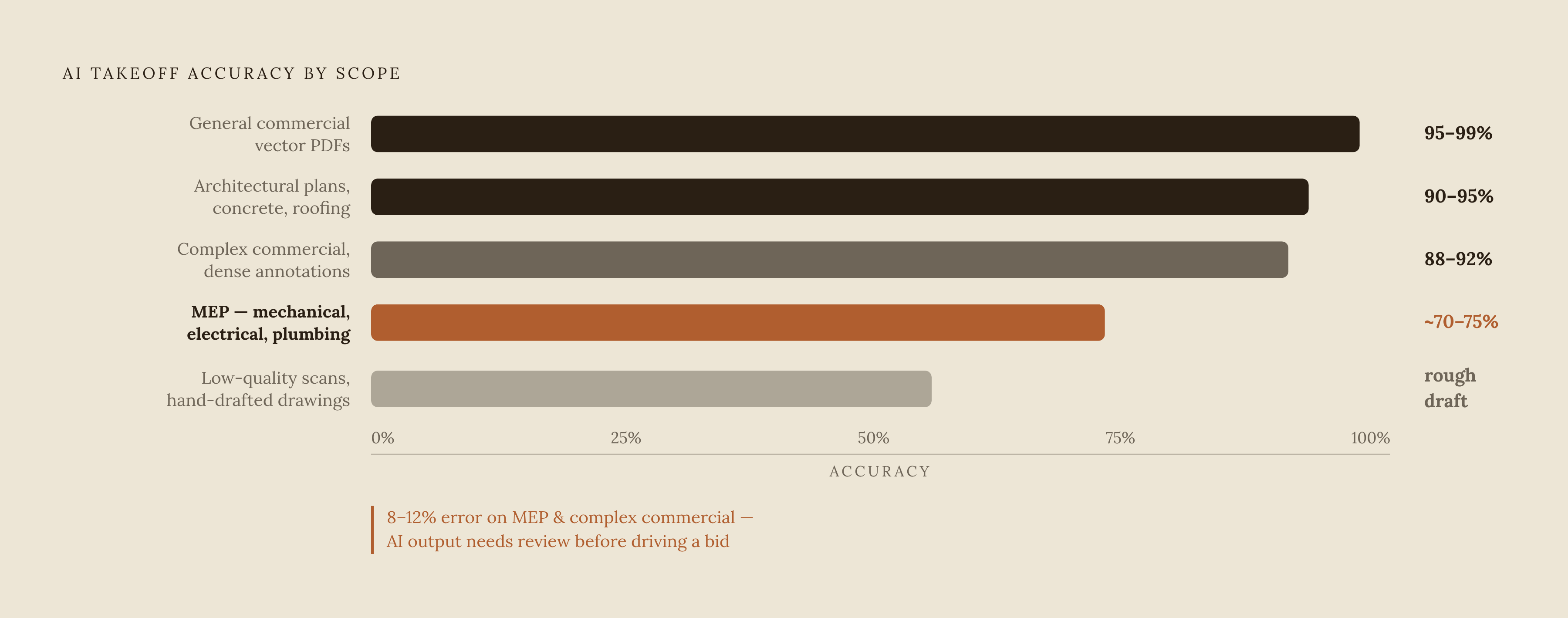
AI performs best where the geometry is regular and the counting repeats: architectural floor plans, sitework, concrete flatwork, drywall and framing, roofing. These scopes run on area measurement, linear runs, and symbols that repeat across a sheet in predictable patterns, what computer vision handles well.
MEP is the persistent trouble spot, and it isn't close. Mechanical, electrical, and plumbing scopes need trade-specific element recognition that general-purpose takeoff engines still handle poorly. Electrical panel schedules and duct runs are where real gaps in AI recognition are commonly observed. Structural reinforcement detail is its own separate problem: dense, overlapping lines that lean on drafting convention rather than anything visually obvious to a model trained on general geometry. Low-quality scans, unusual symbols, and drawing sets with internal conflicts drag accuracy down further on all of it.
Movement is happening here, though it hasn't closed the gap. Trimble announced AI capabilities for MEP estimating in June 2026, aimed at automating object recognition directly from construction drawings. Aginera's DesignOps platform is built specifically for MEP and electrical contractors, processing both PDF and CAD files and pairing computer vision with engineering rule engines to pull quantities and expand every device into full material and labor assemblies. Pricing runs a free Starter tier with 200 AI credits, a Professional tier at $299 per month billed annually, and Enterprise pricing on request. Even with tools like this narrowing the distance, MEP stays the hardest scope in the business to automate reliably, and firms betting bid accuracy on a full MEP handoff to AI are ahead of what the technology can deliver.
What the speed gains mean for bid volume and revenue
Speed by itself is an engineering result. What turns it into a business story is capacity: firms using AI takeoff submit two to three additional bids in the time it used to take to prepare one.
Survey data backs up how firms describe the shift. Among On-Screen Takeoff users, 54% cited "time savings" as the main reason they adopted AI takeoff, which tells you the market will trade a little accuracy fine-tuning for a large jump in throughput. And 68% of surveyed users said they'd be "very disappointed" or "somewhat disappointed" if they lost access to Auto Takeoff, a sign the tool has become something teams depend on rather than something they're still testing.
A mid-sized electrical contractor's experience, reported by nedesestimating.com, shows what that looks like on the ground. The firm switched to AI-powered material takeoffs. Monthly bid volume went from four projects to twelve. The counting phase of estimating dropped from 30 hours to a fraction of that. By the end of 2026, revenue was up 40%, without hiring a single additional estimator. That's the capacity story in one company: not fewer people doing the same work faster, but the same people covering three times the bid volume.
Where manual estimator judgment still protects the bid
None of this makes the estimator's judgment optional, and firms treating AI takeoff as a stand-in for judgment are the ones most likely to get burned on a bid. Spec interpretation sits entirely outside what AI tools currently do. AI reads drawings. It doesn't read spec sections, doesn't weigh a material substitution clause, and doesn't catch the moment a spec section says one thing while a drawing detail shows another. That gap between the two documents is exactly where change orders get born, and closing it is still a human task.
Addenda work the same way. When an addendum changes a wall assembly or swaps a fixture type, an estimator has to understand what that change means for cost and scope, beyond simply re-measuring the affected area. AI tools can flag that a drawing changed. They can't yet tell anyone what the change means for the bid.
Complex assemblies carry their own risk. An estimator who has actually built out MEP systems on past jobs knows when a duct run shown on a drawing can't be installed that way in the field, because of code, clearance, or some other constraint the drawing doesn't show. AI has no site visit behind it, no trade experience, no memory of the code conflict that overrides what's drawn on the sheet.
Then there's the scope gap, arguably the most expensive error category in the business. The costliest items are often the ones that show up in neither the architectural drawings nor the structural drawings, falling into the crack between two disciplines. Catching those takes cross-referencing judgment that AI tools aren't built to supply unprompted, though tools like Provision AI are being built specifically to flag these anomalies before they turn into a problem on-site.
Structuring a workflow that uses both methods where they belong
A four-step process maps out where a person needs to step in. Blueprint ingestion marks step one: AI handles scale detection and processes multi-page plan sets on its own, though an estimator should verify scale by hand on unusual or reduced-size sheets, where automated scale detection slips more often. The second step is AI layer detection, where computer vision identifies walls, areas, openings, and repeated symbols, and the estimator checks that output against the drawing index to confirm nothing's missing. Step three is quantity extraction: AI delivers a structured quantity list, and the estimator spot-checks it against the spec and layers in waste factors and assembly logic. Step four is export to estimate: the quantities flow into estimating software, and the estimator prices the job, applying judgment on alternates, exclusions, and scope qualifications that no software captures on its own.
By scope, the division is fairly clean, and firms that blur it are the ones eating the accuracy losses described above. AI should run as the primary method on architectural, sitework, concrete, drywall, and roofing scopes, with the estimator reviewing the output instead of redoing it. On MEP-heavy scopes, AI output should be treated as a starting point, with the estimator rebuilding or verifying any quantity that carries real material cost risk. On low-quality scans, hand-drafted drawings, or dense structural reinforcement detail, manual takeoff should stay the primary method, full stop, because the drawings themselves work against automation there.
This is not a story about AI replacing estimators. It's a story about the counting phase shrinking from most of a working day down to a fraction of it, and what an estimator does with the hours that frees up is what decides whether a bid wins or loses money.